Coastal weather is difficult on a garage door in manner ins which just become obvious after a season or 2. Salt air infiltrates moving parts, wind stress tests every fastener, and repeated moisture cycles swell timber, boring coatings, and invite rust. On the Gold Coastline and across comparable seaside stretches, a garage door is not just an ease. It belongs to the home's weather barrier, and during severe tornados or cyclones it can end up being the distinction in between an included occasion and a significant architectural problem.
That is why preventative upkeep for garage doors should have even more interest than most homeowners provide it. Individuals often tend to see the door just when it sticks, grinds, or rejects to shut. By then, the damage has usually been developing for months. In a coastal environment, little concerns take a trip swiftly. A seal that has lifted at one corner lets in moist air and debris. A loosened track develops uneven filling on rollers. A garage door motor that seems a little strained can wind up falling short at exactly the incorrect time, typically after a storm, when emergency situation repair work are in highest possible demand.
The useful objective is basic. Maintain the door running efficiently, keep the opening sealed, and see to it the whole assembly prepares to withstand high winds. That implies normal examination, prompt servicing, and a reasonable plan for storm season.
Why seaside problems shorten the life of a garage door
Salt and moisture are unrelenting. Also when the door looks fine from the street, the hardware can be quietly deteriorating. Joints, braces, springtimes, tracks, and fasteners all encounter even more rust near the shore than they do inland. If the building rests where sea air is strong and constant, the price of wear can be surprisingly fast. I have actually seen galvanized parts that must have lasted years start to pit early because no one rinsed or examined them, and the very first apparent symptom was not corrosion, but poor movement.
Wind is the other major element. A garage door is a large surface, and wind stress does not need a full-on cyclone to cause trouble. Throughout severe tornados, the door can bend, rattle, and strain against its assistances. Queensland assistance is clear that garage doors are a well-known weak point in cyclones, and that they must be properly ranked for wind stress or fitted with an ideal supporting system when cyclone problems are approaching. If the door is not appropriately kept, its capacity to do that job goes down sharply.
There is additionally the issue of the entire home envelope. Queensland government products keep in mind that garage door failing can damage surrounding wall surfaces, ceilings, and roof cladding. That matters since as soon as the opening gives way, wind can get in your house and transform the stress profile inside. What starts as a failed door can end up being a much larger structure problem.
What precautionary maintenance actually looks like
The ideal maintenance routine is useful rather than technological. Many homeowners do not require to take apart the door or begin rating spring stress. What they do need is a normal, calm inspection routine that catches wear very early and maintains the door in excellent working order.
A valuable approach is to believe in terms of 5 areas: the surface area, the seals, the moving equipment, the opener, and the structure around the opening. If those 5 are sound, the door is typically in better shape than the average coastal garage door.
The surface area ought to be looked for dents, warping, loosened panels, or indications that the door no more sits equally. On sectional doors, panel joints are worthy of close attention. On roller doors, seek smooth traveling and any type of waviness that suggests the curtain is not rolling properly. Turn doors ought to shut squarely and not lean to one side.
The seals matter more than many people realize. Brisbane and Queensland preparedness advice both stress checking seals and door frames as component of maintaining the home envelope undamaged. A hardened bottom seal or a fractured side seal may seem minor, yet it allows wind-driven rainfall, grit, and pests right into the garage. Over time, that dampness can service hardware, saved items, and the lower side of the door itself.
Moving wood garage doors components need normal eyes-on examination. Tracks should be lined up, rollers must relocate freely, and springtimes or cables should reveal no noticeable damages. I constantly tell house owners to pay attention as high as they look. New grinding, squealing, or hesitation normally indicates something has actually changed. A door that unexpectedly needs even more initiative from the garage door motor is not just frustrating. It may be telling you that friction has boosted, equilibrium has shifted, or an element is wearing unevenly.
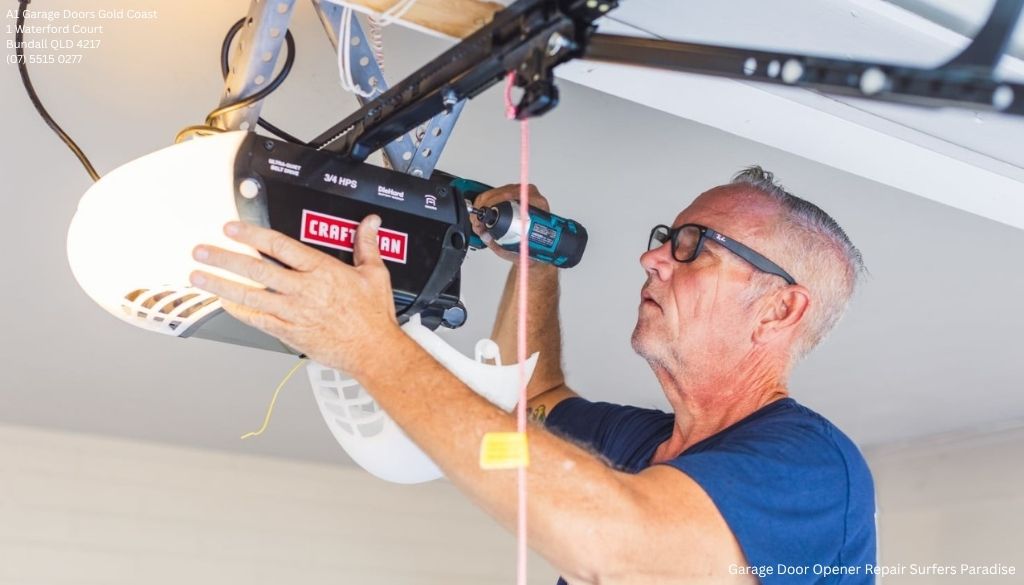
The opener deserves its very own focus. A garage door electric motor that stress, waits, or makes unknown noises might still function today and fall short throughout the next storm cycle. Batteries in remotes ought to be examined, clever controls need to be checked if installed, and the opener must be verified to react regularly. If the door is heavier than it needs to be, the opener will certainly not compensate forever.
Seasonal practices that pay off
Coastal upkeep works best when it is linked to the schedule. There is no requirement to overcomplicate it, but a light, consistent rhythm avoids the kind of troubles that end up being emergency situation repairs.
One great habit is a short monthly evaluation during the warmer, wetter months, when moisture and tornado task are most likely to expose weak points. A 2nd, much more detailed check before storm season makes sense for homes in revealed locations. Queensland storm preparedness advice worries the significance of preparing before severe weather condition shows up, not after warnings are currently rising. That advice uses directly to garage doors.
Here is a basic pre-season list that fits in a single walkaround:
Check that the door opens up and shuts efficiently without grinding or hesitation. Inspect seals for cracking, squashing, or voids at the bottom and sides. Look for rust, loose fasteners, or visible wear in tracks, hinges, and brackets. Test the garage door motor and remotes so there are no surprises during storm prep. Confirm that the door closes fully and rests uniformly against the frame.That is not a replacement for correct maintenance, yet it catches an unusual variety of issues early.
Storm preparedness is not the same as regular maintenance
A garage door can operate completely on a common day and still be susceptible in tornado problems. Coastal house owners often discover this by hand because the door appears fine up until the climate transforms. Regular upkeep maintains it relocating. Storm readiness maintains it from ending up being the weak link in the house.
Queensland preparedness product especially advises homeowners to protect doors, windows, and exterior products prior to extreme climate. For garage doors, that indicates examining whether the door abides by AS/NZS 4505 and is effectively ranked for wind stress, or whether it has a proper bracing system for coming close to cyclone conditions. The point is not academic conformity. It is physical resilience. If the door was set up years earlier, or changed without attention to cyclone demands, it is worth evaluating before the following tornado season.
Homeowners occasionally assume that a hefty door is instantly a solid door. That is not constantly real. Strength depends upon the full system: the panels, the tracks, the correctings, the opener, the framework, and any kind of bracing. A door can look considerable however still stop working if it is poorly maintained or not rated for the local conditions.
If replacement gets on the table, Queensland federal government support keeps in mind that replacing non-compliant garage doors can improve cyclone durability. That is not an informal upgrade. It is a significant architectural improvement, and it often makes even more sense than repetitively patching a door that was never fit to the environment.
When a little problem comes to be an urgent one
Some issues can wait a week. Others ought to relocate promptly, specifically in coastal weather. A damaged spring, a harmed cable, a door that will not shut appropriately, or a motor that stalls repeatedly can develop into an immediate situation quick. If a storm is approaching, these are not the type of mistakes to postpone.
Emergency fixings are garage door resource commonly needed after wind, salt spray, or impact has impacted the door. Even if the door seems running, a bent track or loosened brace can produce concealed danger. The door may function one or two times, then jam halfway on the 3rd cycle. In a storm context, that is not the minute to find the problem.
The functional judgment call is this: if the door no more opens up and shuts efficiently, if the equilibrium seems off, or if there shows up structural damage, quit counting on it as if nothing has actually transformed. It is much better to arrange fixing before the climate intensifies than to require the door into solution and make the damages larger.
There is also a safety issue with diy efforts. Lots of house owners search for just how to repair a garage door after something begins failing. Fundamental troubleshooting is great, but springs, cable televisions, and structural bracing are not the area for guesswork. Those components hold tension or maintain the door steady under lots. If they are incorrect, the repair service can produce extra trouble than it fixes. A sensible owner can remove particles, check seals, and test the opener. Anything beyond that needs to be treated carefully.
Materials, equipment, and the realities of seaside wear
Not all garage doors age the same way. Coastal conditions reveal distinctions that are very easy to miss on an item brochure. Roller doors, sectional doors, and tilt doors each have their own upkeep demands.
Roller doors are preferred due to the fact that they are practical and compact, but their overviews and relocating elements still need focus. Salt and dirt develop with time, and the door can begin running noisily or erratically. Sectional doors supply excellent capability and can be a strong suitable for several homes, but panel joints, hinges, and rollers garage door repair services create more factors that need checking. Tilt doors are mechanically less complex in some aspects, but they still count on proper balance, secure mounting, and an audio frame.
The surface matters too. Coastal sun and dampness are a hard combination, and as soon as surface area security breaks down, deterioration actions quicker. A homeowner that notifications fading, peeling off, or very early rust needs to not treat it as cosmetic only. It commonly indicates that the protective layer is stopping working, which implies the underlying material is a lot more subjected to weather.
Even the garage door electric motor can be impacted indirectly. If the door itself ends up being harder to relocate because of deterioration, misalignment, or harmed equipment, the opener lugs additional lots. Motors are not developed to make up forever for a mechanically weary door. What looks like a motor issue may in fact be an equilibrium or hardware trouble upstream.
Security and securing go hand in hand
In seaside locations, people typically believe initial concerning storms and neglect the day-to-day safety duty of the garage door. Yet both concerns overlap. A well-maintained door is more difficult to require, less most likely to rattle loose, and a lot more immune to meddling. Queensland protection design material refers to roller doors, anti-tamper functions, and padlockable securing systems in safe and secure applications, which is a pointer that stability and protection normally climb together.
Sealing becomes part of this as well. A door with voids is not just more exposed to weather, it is simpler to probe, noisier in strong winds, and less efficient as a boundary. If the framework and seals remain in good condition, the opening feels tighter, quieter, and extra steady. The advantage is not remarkable on a warm day, yet throughout a severe storm the distinction can be obvious.
Homeowners who appreciate safety should think of the entire opening, not just the lock on the garage door. Tracks, side seals, bottom seals, and the integrity of the frame all issue. A safe system is generally a conserved system.
Deciding in between fixing and replacement
There is a point where repeated patching stops making good sense. Coastal climate speeds up that choice. If the door has recurring rust, persistent inequality, repeated opener pressure, or an age that puts it well behind existing tornado expectations, substitute might be the smarter investment. Queensland advice on strength is a useful marker here. If the door is not certified, not properly rated, or not ideal for cyclone conditions, replacing it can materially enhance the structure's capacity to withstand serious weather.
That does not indicate every worn component needs a brand-new door. A good service technician can often restore solution with targeted repair work. A broken seal, a worn out roller, a used wire, or a having a hard time garage door motor may suffice to warrant repair work instead of replacement. However if the fundamental framework is compromised, or if the door has actually ended up being a reoccuring weak point, even more repairs can simply delay the inevitable.
The ideal choice usually comes down to 3 concerns. Is the door mechanically seem? Is it fit to neighborhood wind problems? And is the cost of continued repair work beginning to resemble the expense of a better lasting option? In a coastal environment, that third concern typically matters more than individuals expect.
What an appropriate examination should actually catch
A post-storm or pre-season evaluation is not just an eye the door from the driveway. It needs to expose whether the system is still lined up, secured, and secure to use. Tornados can loosen repairings, shift tracks, damage seals, and expose covert corrosion. Also if the door made it through without apparent damages, it deserves examining before placing it back under regular use.
A cautious evaluation ought to look at the framework, the tracks, the seals, the rollers, the opener, and the noticeable problem of the panels or drape. It should also take into consideration exactly how the door sounded and acted prior to and after negative weather condition. New resonance or rubbing is a hint. A door that sits a little jagged after a storm may still open up, but that does not make it healthy.
If damage is discovered, withstand the temptation to compel the door via a couple of more cycles. That is how a little distortion becomes an obstructed track, a damaged cable television, or a fallen short opener. Emergency situation fixings typically begin as a hold-up in taking care of visible warning signs.
A maintenance attitude that in fact works
The homes that cope best with seaside climate generally have proprietors who focus prior to points fall short. They do not wait on rust to become architectural, or for a loud opener to stop totally. They look after the door due to the fact that they recognize what it is protecting. That way of thinking is particularly vital on the Gold Shore and in various other areas where strong winds and extreme tornados are part of life, not rare anomalies.
Good preventative upkeep for garage doors is not complicated, yet it does require technique. Keep the door tidy sufficient to see modifications. Inspect seals and frameworks. Expect corrosion. Examine the electric motor. Take notice of equilibrium and sound. Deal with storm season as a due date, not a background condition. And if the door is no longer suitable for the wind lots it may encounter, do not hold on to it out of habit.
A garage door that is serviced properly, sealed appropriately, and matched to the regional weather is quieter, much safer, and much less most likely to demand pricey emergency repair work when the forecast transforms serious. In coastal problems, that is not a deluxe. It is basic structure sense.